The Saturday Morning Ritual That Followed Me Out Of Religion

Most of us grow up with at least one ritual we never think to question. Not because we believe it deeply, but because it arrives fully formed, already in motion.

Mine came with a steel bowl, mustard oil, and the Lord of Saturn.


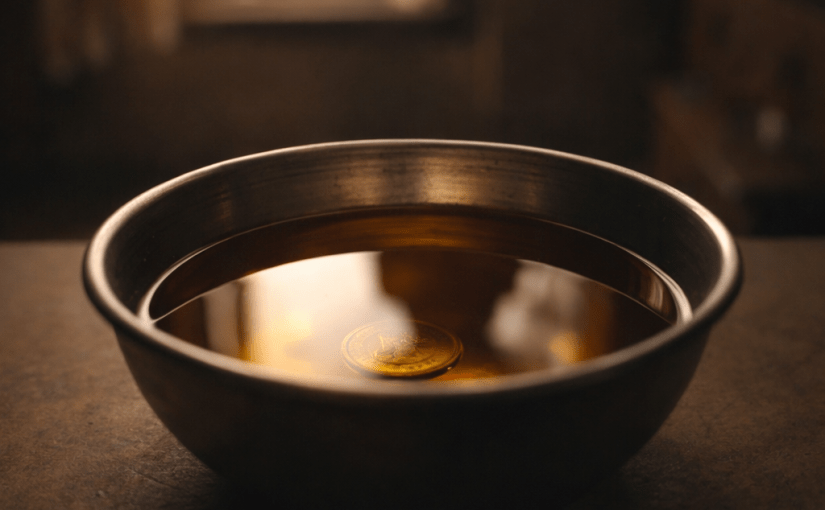
A steel bowl, a coin, a reflection. We knew the steps. Not the reason.

Every Saturday between 7–8 AM, you could hear him coming. That deep, carrying voice cutting through the morning, chanting Jai Shanidev (hail the Lord of Saturn), moving from door to door. He wore a white shirt and white pants and carried a steel canister and cloth bags on his shoulders to collect dry rations.

By the time he reached our door, the steel bowl was already out, filled with mustard oil and a rupee coin at the bottom. Everyone in the family had to see their reflection before it was handed over.

Then you handed it over along with flour, black urad dal (Saturn’s grain, heavy and dark), and sometimes sugar, and went back to your parathas (buttery Indian flatbread) because the ritual was done and breakfast was waiting.

We didn’t question it. We timed our mornings around it.


Before Google, how many rituals survived simply because there was nowhere to question them?

I remember asking my parents once what the reflection was for. Were these rituals explained anywhere?

My mother said it was probably to ward off the evil eye. Besides, a small donation never hurt anyone. It multiplies as a good deed. My father agreed from behind his newspaper. That was another ritual in our household entirely, but that’s a story for another day.

Nobody seemed particularly concerned with the exact reason. The ritual had to be done and that was the end of it.

For a long time, the lack of an answer stayed with me.

Years later, in a completely different life, I found myself looking it up.

It has a name. Chaya Daan. Shadow donation. See yourself clearly before your hands let go of something.


Which reminded me of a guest who once found a steel bowl of mustard oil on our kitchen shelf, set aside for donation.

In our homes, mustard oil moves easily between ritual and routine.

So they used it.

It was only when they touched the coin at the bottom that the meaning of it changed.

They were mortified. My brother and I were absolutely hysterical.

Luckily there is a prayer for forgiveness. It’s called Kshama Prarthana. You say it out loud, humbly, something like: I did not know. I did not mean it. Whatever I did, my actions, please forgive it all. The guest said those words, we poured a fresh batch of oil into the bowl, moved the coin back keeping it ready again for donation, and Saturday continued as normal.

The ritual had its own form of error handling built in, which honestly shows a level of practical wisdom I have a great deal of respect for.

Maybe that was always fine. Maybe the doing was the point.


Did the internet free us from religion or did it just give us permission to admit we were already gone?

The man collecting oil door to door turned out to be part of a bigger network. The oil didn’t disappear into devotion. It moved into shops, into kitchens, onto someone else’s tawa (an Indian flat griddle) on someone else’s Saturday morning. People cooking with it had no idea where it had been.

My parents were devoted people in a world with no search bar and no real reason to look anything up.

The bowl was kept ready, and goods for donation were set aside because that’s what you did. The meaning lived in the doing. Nobody asked for a source.

I grew up in that same house, with the same rituals, the same unquestioned rhythms. Years later, I found myself sitting up late at night, looking up the very things no one had thought to question.

Not because I’m smarter. Just because I had wifi and they didn’t.

What stayed was the part that had nothing to do with belief, making sure someone else could have what we had in surplus.


These days I post in local giveaway groups. Because if I have three winter coats and someone has none, that person should have one.

The religious meaning didn’t make it. The human one did.

Some rituals outlast the religion they came wrapped in.


What’s the ritual you grew up with that nobody ever explained? Leave it in the comments.

I Grew Up Hindu in India. Now I Raise My Kids Without Religion.

I didn’t lose my religion. I outgrew it, not all at once, but over time. Quietly, the way a dupatta catches fire when you’re not paying attention.

A dupatta is the long chiffon scarf South Asian women drape over their heads during prayer, among other things. A garment that exists, in part, to signal modesty and devotion. Mine, it turned out, was flammable.

But we’ll get to that.


Growing up in Chandigarh, India in the 90s, questioning God wasn’t rebellion. It wasn’t even a thought. Religion was the water you drank, handed to you fully formed before you were old enough to ask where it came from. We offered prayers before exams, during illnesses, when moving into a new home. God was the silent guest at every milestone. The one you really didn’t want to upset.

Especially not on Saturdays. On Saturday mornings a man came door to door collecting mustard oil and dry rations, donations for Shanidev, the God of Saturn. The one you didn’t want to anger. We had the offering ready. Everyone did. Nobody asked why.

I was good at all of it. Every Monday morning, buttermilk offered to the Shivling at the temple, Lord Shiva’s sacred form. On Tuesdays, the whole city observed Lord Hanuman’s day, barber shops stayed shut, and no one ate meat, eggs, or drank liquor. Not just our family. Everyone. The streets knew what day it was. Thursdays followed a quieter version of the same rule, no meat, no eggs. By the time you got to the weekend you’d practically forgotten what normal eating looked like.

The Monday fasts had a specific purpose: to marry someone of your choice, someone as charismatic and devoted as Lord Shiva himself. I did marry a man of my choice. He is a wonderful human being and a genuinely excellent partner. So perhaps the fasts worked. Or perhaps what I was really doing, without the language for it yet, was deciding very clearly and very young exactly what I wanted. Manifestation dressed in ritual. The intention was always mine.

And at night, when the lights went out and the house made sounds houses make, we didn’t call for our parents first. We recited the Hanuman Chalisa. Forty verses committed to memory specifically for this, for darkness, for fear, for the unnamed things children imagine in corners. The prayer was the protection. The words were the wall.


Then a few small moments arrived, starting around age ten, that left me quietly bewildered. Not rebellious. Not angry. Just wondering. The kind of wondering you fold up very small and put somewhere quiet because you’re ten years old in a traditional Indian home and some thoughts are not said out loud.

The wondering didn’t disappear. It waited.

For years, belief became something I performed rather than felt. I knew what to say, when to pray, how to appear devout. Fear kept me in place longer than faith did, fear of being wrong, fear of consequences, fear of disappointing everyone who had taught me the words in the first place.


Then London in 2005. I was nineteen, arriving with two suitcases and a head full of prayers I was already performing on autopilot. The UK had a state church and a monarch who was its head. It also had an entire population that had quietly stopped turning up. Nobody organised their week around which god might be watching. Nobody knocked on doors collecting mustard oil. They ate what they wanted on any day of the week. They washed their hair on Tuesdays. On Thursdays. On Saturdays. And somehow the sky didn’t fall.

Away from the architecture of expectation I had grown up inside, I met people who were kind, grounded, purposeful and completely without religion. Not damaged by its absence. Not morally adrift. Just free in a way I hadn’t seen modelled before.

Something that had been quietly waiting in me since childhood finally exhaled.

I spent the better part of a decade in the UK. I built a life there, found my footing, and met the man I would marry, the one the Monday fasts had apparently been lining up for me all along. When we decided it was time to put down permanent roots, we chose Ottawa. Deliberately, consciously. A place where we could become whoever we wanted to be.

Then motherhood. Twice over.


Now I have an eight year old who has never offered buttermilk to anyone on a Monday morning. When she asks why things go wrong, I don’t tell her to pray. I tell her we’ll figure it out together. I tell her God isn’t real, and then, because that’s only half the conversation, I tell her that’s nothing to be smug about. That belief does real things for real people. That you can hold your own truth without needing to take someone else’s apart.

We still light diyas at Diwali. We still put up a Christmas tree in December. We carry the culture, the food, the language, the festivals. We just left the mythology behind somewhere between Chandigarh and here.

I don’t whisper prayers into their ears. I whisper questions.


If any of this sounds familiar, the rituals you performed without feeling, the doubt you carried quietly, the home you’re building differently, you’re not reading the wrong blog.

This is where that story begins. If you want to follow it, subscribe below — new chapters arrive when they’re ready.